Harper Lee’s limited bibliography, combined with her notoriously private nature, has created one of the most compelling markets for signed modern first editions. This guide explores the unique characteristics of collecting signed Harper Lee books, addressing authentication challenges, valuation principles, and acquisition strategies.
The Exceptional Nature of Harper Lee’s Signature Market
Several factors make Harper Lee’s signature market distinctive among literary collectibles:
- Her primary work, “To Kill a Mockingbird,” ranks among the most beloved American novels
- Her intensely private nature and reluctance to engage in public appearances
- Her limited publishing history (only two novels published during her lifetime)
- Her well-documented aversion to signing books in her later years
- The 55-year gap between her two published novels
These elements create a market characterized by exceptional scarcity and sustained demand.
To Kill a Mockingbird: The Cornerstone of Lee Collecting
First Edition Identification (1960)
The true first edition of “To Kill a Mockingbird” from J.B. Lippincott presents several key identification points:
- Statement “First Edition” on copyright page
- Brown cloth binding with brown and green stamping
- Price of $3.95 on dust jacket flap
- No mention of literary prizes on the dust jacket
Signature Valuation
Signed first editions of “To Kill a Mockingbird” represent some of the most valuable modern literary collectibles:
- First edition with authentic signature: $25,000-50,000 depending on condition
- First edition with personalized inscription: $30,000-75,000
- Later printings with authentic signature: $8,000-15,000
- Book club editions with signature: $4,000-7,000
Go Set a Watchman (2015)
Harper Lee’s second novel presents a complex case for collectors:
- Signed first editions are exceptionally rare due to Lee’s advanced age and health during publication
- Questions surrounding Lee’s participation in the publication process
- Signed copies from the limited event at Barnes & Noble in Huntsville, Alabama (her only “public” signing for the book) command $4,000-8,000
- Secretarial signatures on promotional copies create authentication challenges
Harper Lee’s Signature Characteristics
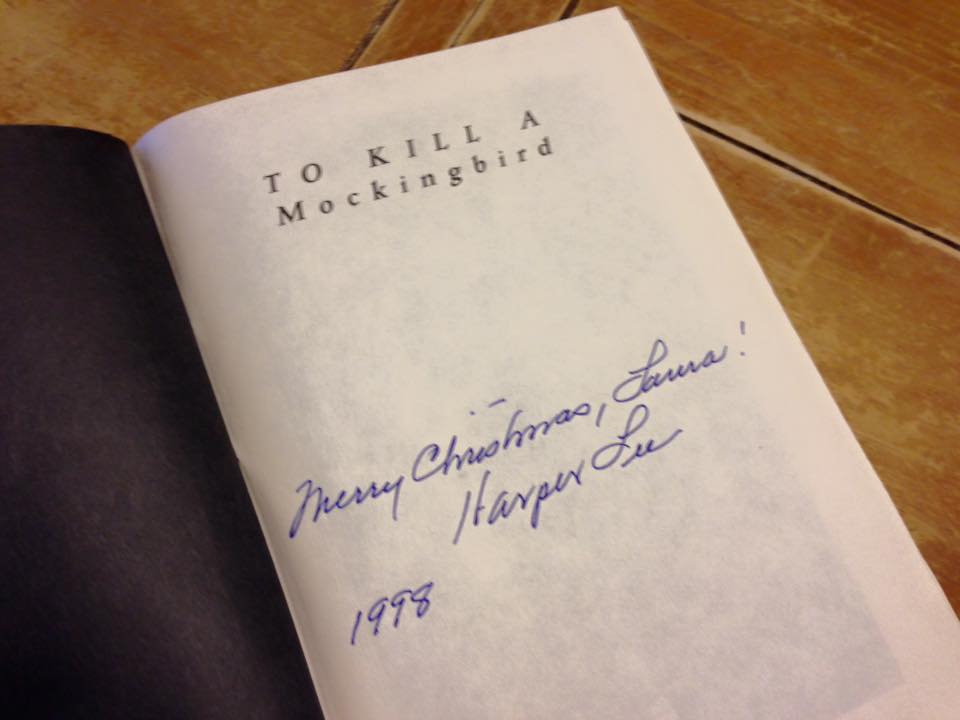
Authentic Harper Lee signatures display several consistent characteristics:
- A flowing, elegant style with distinctive formation of “H” and “L”
- Consistent spacing between first and last name
- The “H” features a distinctive right-leaning crossbar
- The “L” in “Lee” typically features a pronounced loop
- Earlier signatures (1960s) tend to be more carefully formed than later examples
- Often signed simply as “Harper Lee” without additional inscription
Her signature evolved subtly over time:
- 1960s signatures appear more deliberate and formal
- 1970s-1990s signatures maintain consistent form but show slight variations in size
- Post-2000 signatures occasionally display minor tremors consistent with aging
Authentication Challenges
The high value of Harper Lee signatures presents significant authentication obstacles:
- Limited exemplars for comparison due to her reluctance to sign
- Numerous secretarial signatures, particularly on correspondence
- The proliferation of sophisticated forgeries following the publication success of “Mockingbird”
- Confusion regarding signatures from her late-life period (post-2010)
Professional authentication through PSA/DNA, Beckett Authentication, or JSA is strongly recommended before any significant purchase.
Harper Lee’s Signing History and Habits
Unlike many authors, Lee’s signing opportunities were exceptionally limited:
- Initial book tour for “To Kill a Mockingbird” (1960-1961)
- Occasional signings for friends and associates in her hometown of Monroeville, Alabama
- A very limited number of signing events in the 1970s and 1980s
- Her famous reluctance to sign multiple copies or for commercial purposes
- Her eventual refusal to sign copies of “To Kill a Mockingbird” at all in her later years
This limited signing history contributes significantly to the scarcity of authentic examples.
Alternative Collecting Opportunities
Beyond signed novels, collectors might consider:
- Signed magazine appearances – Lee’s 1960 McCall’s excerpt from “To Kill a Mockingbird” signed by Lee ($4,000-8,000)
- Signed letters – Personal correspondence, especially with literary content ($3,000-10,000)
- Signed photographs – Exceptionally rare, typically from her early publicity period ($5,000-12,000)
- Signed legal documents – Documents from her earlier career as an airline reservation clerk or legal documents ($2,000-5,000)
Investment Considerations
Harper Lee signed items have demonstrated remarkable appreciation, with several factors influencing valuation:
- Condition remains paramount, with fine examples commanding significant premiums
- Provenance documentation has become increasingly critical for authentication
- Association copies (books inscribed to notable individuals) can command substantial premiums
- The 2016 passing of Harper Lee has further restricted supply, strengthening prices