Ernest Hemingway’s influence on 20th-century literature remains unparalleled, making his signed works among the most prestigious acquisitions for serious book collectors. This comprehensive guide explores the market for Hemingway-signed books, addressing authentication challenges, valuation principles, and strategic approaches for collectors.
Understanding the Hemingway Signature Market
Hemingway’s status as one of America’s most celebrated authors creates exceptional demand for his signature. Several factors make this market particularly compelling:
- His relatively short life (1899-1961) and limited signing opportunities
- The literary significance of his major works
- His distinctive, recognizable signature that evolved throughout his career
- Strong international collector interest spanning multiple generations
Significant Hemingway Signed First Editions
The most valuable Hemingway signatures appear on first editions of his major works:
The Sun Also Rises (1926) – Signed first editions of Hemingway’s breakthrough novel typically range from $45,000-85,000 depending on condition and provenance. The Scribner’s first edition with original dust jacket represents the most desirable configuration.
A Farewell to Arms (1929) – Authentic signed first editions command $35,000-65,000. The first edition was released with several dust jacket variants, with the earliest “Katherine Barclay” misspelling bringing premium values when signed.
For Whom the Bell Tolls (1940) – Signed first editions range from $25,000-45,000, with presentation copies to significant recipients commanding substantially more.
The Old Man and the Sea (1952) – Hemingway’s Pulitzer Prize-winning novella in signed first edition typically sells for $18,000-30,000. Limited edition signed copies published by Charles Scribner’s Sons can reach even higher prices.
Limited Editions and Presentation Copies
Hemingway occasionally participated in special limited edition publications:
In Our Time (1924) – The Paris Three Mountains Press edition, limited to 170 copies, is exceedingly rare with Hemingway’s signature, with examples selling above $75,000 when available.
The Spanish Earth (1938) – Limited to 1,000 signed copies, this work typically sells for $8,000-15,000 when found in its original configuration with slipcase.
Presentation copies with personalized inscriptions to notable recipients can command significant premiums, sometimes doubling or tripling the value of a standard signed first edition.
Hemingway’s Signature Characteristics
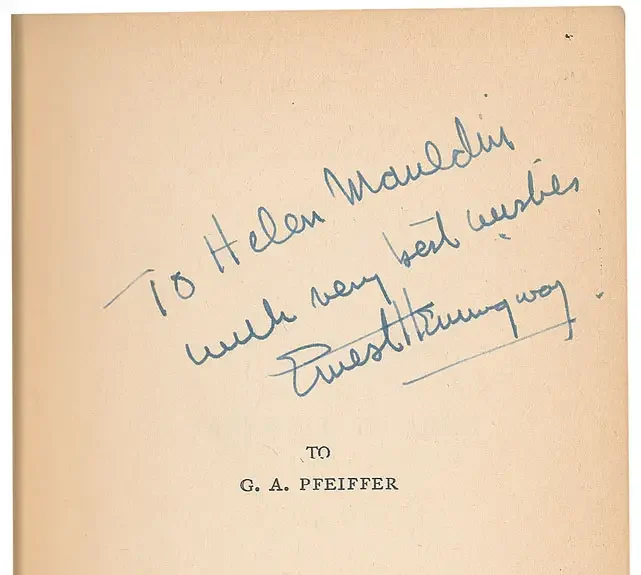
Authentic Hemingway signatures display several distinctive characteristics:
- An elegant, flowing style that became more compact in later years
- The characteristic long crossing of the “t” in “Ernest”
- A distinctive capital “H” in Hemingway with a prominent rightward flourish
- Often signed in blue or black ink
- Occasional inscriptions that reference hunting, fishing, or bullfighting for associates who shared these interests
His signature evolved noticeably through his career:
- 1920s signatures tend to be more expansive with flourishes
- 1930s signatures show a more controlled, deliberate hand
- Post-WWII signatures often appear slightly more hurried but remain consistent in formation
Authentication Challenges
The high value of Hemingway signatures has unfortunately led to sophisticated forgeries. Authentication challenges include:
- Numerous secretarial signatures, particularly on correspondence
- Forgeries based on signatures reproduced in auction catalogs
- “Cut and paste” forgeries using authentic signatures transferred to valuable books
Professional authentication through recognized services such as PSA/DNA or Beckett Authentication is strongly recommended for significant purchases.
Hemingway Signing Habits and Opportunities
Unlike many modern authors, Hemingway did not participate in commercial signing events. Most authentic signatures derive from:
- Books presented to him personally by friends and associates
- Limited edition publications explicitly intended for signing
- Personal correspondence with his publishers and literary contacts
- Occasional inscriptions for patrons at his favorite establishments in Key West, Cuba, and Spain
This limited signing history contributes significantly to the scarcity and value of authentic examples.
Collecting Strategy and Market Entry Points
For collectors interested in acquiring Hemingway-signed materials, several approaches merit consideration:
- Letters and correspondence – Signed Hemingway letters, particularly those with literary content, offer an entry point typically starting around $5,000-8,000.
- Later works – Signed copies of “Across the River and Into the Trees” (1950) and “Islands in the Stream” (published posthumously) typically command lower prices than his most celebrated titles.
- Typed manuscripts with corrections – These occasionally appear at auction and provide insight into Hemingway’s creative process, ranging from $3,000 for a single page to $50,000+ for significant works.
- Photographs – Signed photographs of Hemingway, while not bibliographic items, provide another collecting avenue, typically ranging from $2,500-6,000.
Investment Considerations
Hemingway signed books have demonstrated consistent value appreciation over decades, with several noteworthy considerations for investment-minded collectors:
- First editions in exceptional condition with intact dust jackets command the highest premiums
- Provenance documentation has become increasingly critical for maintaining value
- The market shows particular sensitivity to condition issues like sunning, foxing, or restoration
- International demand, particularly from European and Japanese collectors, helps maintain strong valuations