The market for George R.R. Martin signed books has undergone a remarkable transformation, evolving from a niche science fiction collecting category to one of contemporary literature’s most dynamic investment opportunities. This comprehensive guide examines the market for Martin’s signed works, analyzing valuation trends, authentication challenges, and strategic collecting approaches.
The Evolution of the Martin Signature Market
George R.R. Martin’s collecting market has experienced several distinct phases:
- Pre-1996 Era: When Martin was primarily known as a science fiction and horror writer with a dedicated but limited following
- A Game of Thrones (1996-2010): The period between the publication of the first novel and the HBO adaptation
- Post-HBO Adaptation (2011-Present): The explosion of mainstream popularity following the television series
This evolution creates unique opportunities for collectors who understand the nuances of each market phase.
A Song of Ice and Fire: Core Collecting Focus
The “A Song of Ice and Fire” series represents the primary focus for most Martin collectors:
A Game of Thrones (1996)
- First edition identification: True first editions from Bantam Spectra feature full number line “98765432” on copyright page and $21.95 price on dust jacket
- Signed first edition values: $3,000-6,000 depending on condition
- Signed advance reading copies (ARCs): $1,500-3,000
A Clash of Kings (1998)
- First edition signed: $1,800-3,500
- First edition signed and dated from release period: $2,500-4,000
A Storm of Swords (2000)
- US first edition signed: $1,500-2,800
- UK first edition signed (significantly rarer): $2,000-3,500
A Feast for Crows (2005)
- First edition signed: $800-1,500
- Limited editions from Subterranean Press: $1,500-3,000
A Dance with Dragons (2011)
- First edition signed: $600-1,200
- Signed and dated from release tour: $800-1,500
Early Works: The Foundation of Serious Collections
Martin’s pre-ASOIAF works represent exceptional value for serious collectors:
Dying of the Light (1977) – Martin’s first novel
- Signed first edition in dust jacket: $2,500-4,500
- Signed first edition without dust jacket: $800-1,500
Windhaven (1981, with Lisa Tuttle)
- Signed by both authors: $1,000-2,000
- Signed UK first edition: $1,200-2,200
Fevre Dream (1982)
- Signed first edition: $1,200-2,500
- Signed limited edition from Dark Harvest (1982): $800-1,600
The Armageddon Rag (1983)
- Signed first edition: $1,000-2,000
- Increasingly difficult to find in collectible condition
Limited Editions and Special Publications
Martin has collaborated with specialty publishers on numerous limited editions:
Subterranean Press has produced beautiful limited editions of Martin’s work, including:
- “A Knight of the Seven Kingdoms” signed limited: $750-1,500
- “The Ice Dragon” signed limited: $600-1,200
Cemetery Dance Publications offerings include:
- “GRRM: A RRetrospective” (2003): $700-1,400
- “The Skin Trade” signed limited: $400-800
Signature Characteristics and Evolution
Martin’s signature has evolved noticeably throughout his career:
Early Period (1970s-1980s)
- Often signed as “George R. R. Martin” with periods
- More deliberate, carefully formed signature
- Sometimes includes the date
Middle Period (1990s-2010)
- Transition to “George RR Martin” without periods
- More flowing, consistent signature
- Often accompanied by house sigils or “Winter is Coming” inscriptions for ASOIAF books
Current Period (2011-Present)
- Increasingly abbreviated as his signing volume increased
- Sometimes appears as “GRRM” on items signed at large events
- May include personalization for individual collectors
Authentication Challenges
The high value of Martin signatures presents several authentication challenges:
- Limited signed stock from early career when signing opportunities were fewer
- The explosion in value following HBO’s adaptation created incentives for forgery
- Martin’s signature can vary based on signing circumstances (convention vs. private signing)
- The proliferation of secretarial signatures, particularly on promotional materials
When purchasing valuable Martin signed books, authentication through recognized services like PSA/DNA or JSA is strongly recommended.
Martin’s Signing History and Access Points
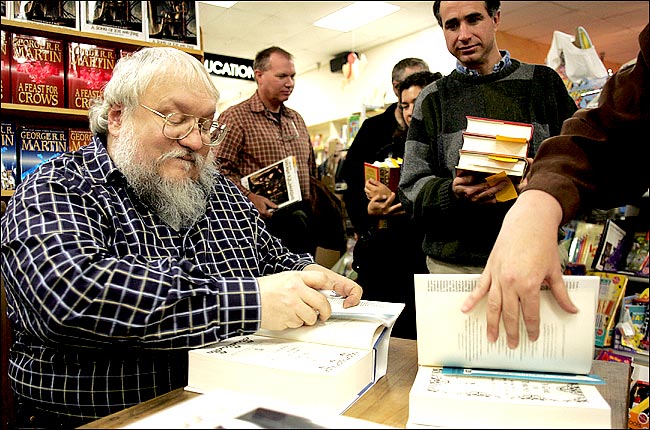
Martin’s approach to signing has evolved throughout his career:
Early Career (1970s-1990s)
- Readily accessible at science fiction conventions
- Generous with his time and signatures for fans
- Willing to sign multiple items per person
Mid-Career (2000-2010)
- Increasingly structured signing events
- Continued attendance at major conventions but with more limitations
- Development of specific signing protocols
Current Era (2011-Present)
- Highly regulated signing events with strict limitations
- Reduced public appearances focused on specific promotions
- Occasional signing of stock for select booksellers
Strategic Collecting Approaches
For collectors entering this market, several approaches merit consideration:
- Focus on early works – Martin’s pre-ASOIAF novels and collections represent excellent value relative to their scarcity
- Consider UK first editions – Often overlooked by US collectors but increasingly valuable
- Specialty press publications – Limited editions from Subterranean Press and Cemetery Dance offer controlled scarcity
- Unique inscriptions – Books with character-specific inscriptions or sketches command premiums
- Association copies – Books inscribed to notable individuals in science fiction or television
Investment Considerations
Martin signed books have demonstrated remarkable appreciation over the past decade, influenced by:
- The continued popularity of the HBO series and its successor programs
- The anticipation surrounding the completion of the ASOIAF series
- Martin’s reduced signing schedule as he focuses on writing
- The crossover appeal to both book collectors and media memorabilia collectors
First edition identification becomes particularly critical for investment-grade copies, with condition playing a significant role in valuation.